
AI Isn-39_t Underperforming_Your Processes Are

AI Isn’t Underperforming. Your Processes Are.

There’s a growing unease in boardrooms. The AI budget was approved, the tools were bought, the team was trained. Everyone agrees it’s impressive. And yet, when you look at the numbers that actually matter — revenue per employee, cycle time, cost to serve — very little has moved.


The conclusion most people are reaching is that AI was oversold.


I think the conclusion is wrong. What’s been oversold is the idea that you can buy AI without changing anything else.

The retrofit trap

Here’s what it looks like in practice. Your agency now writes campaign copy in four minutes instead of four hours. Genuinely remarkable. And your campaign still takes six weeks to go live.


Why? Because the six weeks were never about the copywriting. They were about the brief being written on Monday, reviewed on Thursday, revised the following week, sent for approval, batched into a monthly review, and scheduled around a production calendar that assumes everything takes time.


That entire structure — the handoffs, the review gates, the weekly cadence, the approval chain — exists because human beings were the bottleneck. It was built to manage scarcity. Remove the scarcity at one step, and the scaffolding built around it doesn’t fall away. It just absorbs the gain.


This is the retrofit trap: we’ve made steps faster inside processes that were designed around slow steps. The task speeds up. The system doesn’t. And it’s the system that shows up in the P&L.


Almost nobody designed these processes. We inherited them. They accumulated. Which is why this isn’t an indictment of anyone’s judgement — it’s just that AI has made the seams visible for the first time.

The same mistake, in four different rooms

Marketing. Every step is faster — research, copy, design variants, reporting. The campaign still takes six weeks, because approval is monthly and production is a queue.


Hiring. Five hundred applications used to take a recruiter a week to shortlist. AI does it in an hour. But the company still runs five interview rounds over three weeks, because that process was designed for a world where shortlists were unreliable. Hiring still takes a month. You fixed the one-week part and left the three-week part exactly as it was.


Reporting. Someone used to spend three days a month pulling numbers into a deck, because leadership couldn’t see the data themselves. AI now produces that deck in ten minutes. It feels like a clear win. But the deck only ever existed as a workaround for not being able to ask a question and get an answer. The AI-native version of that process doesn’t have a faster monthly report. It has no monthly report.


Customer support. AI drafts responses in seconds. But the L1/L2/L3 tiers remain, and the SLAs are still written around queue time — both of which exist because human attention was expensive and had to be rationed. The AI-native version isn’t a faster ticket. It’s a product that answers the question at the point of confusion, so most tickets are never raised.


Collections is the same story: instant AI-drafted reminders, still sent on a monthly cycle behind an ageing report that only exists because nobody could watch every invoice at once.


Notice the pattern. Retrofit makes work faster. AI-native makes work unnecessary.

The real opposition isn't inefficiency. It's inertia.

Inefficiency has no defenders. Nobody stands up in a meeting to argue for the six-week campaign.


Inertia has plenty of defenders — and they are reasonable people with reasonable fears.


What if the new system fails? The old process is slow, but it is survivable and predictable. Nobody has ever been fired for a six-week campaign. People do get fired for a broken one. Slowness is a shared, invisible cost. Failure has a name attached to it.


What if this is a bubble? Everyone in a leadership role has lived through at least one transformation programme that quietly died. Rebuilding your core operations around a technology that might deflate feels reckless. So people wait — and waiting looks a lot like prudence.


And the question nobody says out loud: if the process shrinks, what happens to the person who managed it? Redesigning a process usually means fewer handoffs, fewer roles, fewer meetings. You are asking people to redesign themselves out of relevance and then wondering why adoption is slow.


Once you see this, the popularity of tool-buying makes complete sense. Buying a tool is a low-risk gesture. It looks like progress, it threatens nobody, and it changes nothing. That, more than any limitation of the technology, is why AI investment isn’t showing up in outcomes.


I’ll admit we learned this the hard way ourselves. We built a large internal AI framework for our content team — skills, SOPs, prompt libraries, hundreds of documents. It was good work. The team barely touched it, because using it meant each person voluntarily redesigning their own way of working, on top of their actual job. It only started producing value once we stopped handing out capability and rebuilt the process itself, so the new way was simply how work happened. The lesson was uncomfortable and useful: toolkits don’t get adopted. Systems do.

About the bubble

Let’s be honest about the froth, because it’s real. Valuations are stretched. Companies are raising on narrative. A great many products have bolted on a chatbot and repriced themselves as AI companies. Some meaningful share of what’s being funded today will not exist in three years.


But I want to separate two things that keep getting collapsed into one: the market and the capability.


I’m not a reflexive believer in new technology. I never thought blockchain would fundamentally change anything, and a decade after the peak of that hype, here we are. It has had real impact in a few narrow places. It has not come close to what was promised. And the tell, in hindsight, was that you always had to be told why it mattered. It needed a whitepaper, an evangelist, a future tense.


AI needed none of that. Nobody had to be convinced. People used it once and were amazed — and I don’t think there’s a single honest person who can say otherwise. Beyond the feeling, there’s a harder signal: it is already doing real work, at scale, every day, paid for out of operating budgets rather than innovation budgets. Blockchain never crossed that line.


So yes, the market may correct. Bubbles pop; that’s a statement about prices, not about whether a capability disappears. Railways, telecom, the internet — the valuations collapsed, the infrastructure stayed, and the real productivity arrived afterwards, once the noise cleared and people finally rebuilt their operations around what had been laid down.


Which makes this an unusually asymmetric bet. Convert to AI-native operations and the market crashes — you still have a faster, leaner, cheaper business. Wait for certainty and it doesn’t crash — you’ve handed your competitors a two-year head start that can’t be bought back later at any price.


We are not going back to the pre-AI world. That much seems settled.

The question worth asking

Stop asking where can AI help us do this faster? That question can only ever produce a retrofit.


Ask instead: if we were starting this business today, with these tools, would this process exist at all?


It’s a harder question, and it produces uncomfortable answers. Most processes fail it. That’s the point. The real measure of how AI-native a company is isn’t how many tools it has bought — it’s how many processes it has deleted.


None of this is a technology problem. The technology is available to everyone, at roughly the same price, today. It’s a leadership problem, because redesigning a process means someone has to accept risk they aren’t currently paid to take. That’s the actual bottleneck, and no vendor can solve it for you.


If you want a place to start, don’t start everywhere. Pick one process — one that everybody privately agrees is bloated — and redesign it from zero, as if the old version never existed. Don’t touch anything else. Get it working, let people see the difference, and let the appetite build from there.


The companies that do this over the next two years won’t be the ones with the best AI. They’ll be the ones that were willing to give up processes that still, technically, work.

How an AI SEO Agency Helps You Get Cited by ChatGPT_Gemini - Perplexity

How an AI SEO Agency Helps You Get Cited by ChatGPT, Gemini & Perplexity

A client asked me last month why their top competitor kept showing up inside ChatGPT answers when someone asked “best project management software for small teams,” while their own site, which outranks that competitor on Google for the same phrase, never got a single mention.


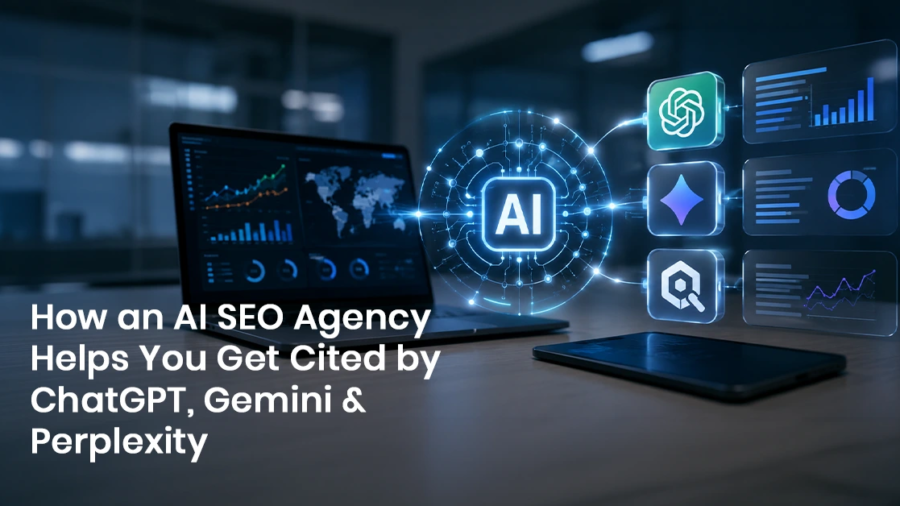
That question is becoming the whole ballgame in marketing right now. Ranking #1 on a search results page used to be the finish line. Now there’s a second, quieter race happening: getting your brand named, quoted, or linked inside the answer itself when someone asks ChatGPT, Gemini, or Perplexity a question your business could answer. This is the world of Answer Engine Optimization (AEO), and it runs on different rules than the SEO playbook most businesses have spent a decade mastering.

Search Traffic Isn't Disappearing. It's Splitting in Two

People still Google things. But a growing share of research, comparison shopping, and “what should I buy/use/hire” questions now happen inside a chat window instead of a search bar. The person never clicks through ten blue links. They read a synthesized answer, and if you’re lucky, your brand is one of the two or three sources that answer leans on.


That’s a fundamentally different prize to compete for. Traditional SEO optimizes for a ranking position. AEO and its close cousin, generative engine optimization (GEO), optimize for something closer to “would a language model trust this page enough to quote it.” Those aren’t the same skill, which is exactly why a lot of agencies that are excellent at classic SEO are still figuring out this newer discipline, and why the ones that have figured it out are getting hired fast.

What Answer Engine Optimization Actually Means

AEO is the practice of structuring your content, your data, and your brand’s footprint across the web so that AI systems can easily find you, understand what you do, and confidently cite you when answering a relevant question.

It sounds similar to SEO because it shares some DNA with it. You still need solid content and a technically healthy site. But the target reader has changed. You’re no longer writing primarily for a person scanning a search results page; you’re writing for a model that’s trying to extract a clean, verifiable answer it can hand to someone else. That changes what “good content” looks like:

  • Directness over cleverness. A model looks for a clear, well-labeled answer near the top of the page, not a 400-word story before you get to the point.
  • Structure a machine can parse. Headers, lists, tables, and FAQ blocks aren’t just for skimmers anymore. They’re what makes a passage easy to lift and cite.
  • Verifiable specifics. Numbers, dates, named sources, and original data give a model something concrete to attribute to you, rather than a vague claim it has to hedge on.

None of this replaces good SEO fundamentals. It sits on top of them.

GEO and LLM SEO: Same Family, Slightly Different Focus

You’ll see generative engine optimization and LLM SEO used almost interchangeably with AEO, and in practice, most agencies bundle all three into one service line. If you want the fine print distinction: AEO tends to describe optimizing for the answer itself, being the source an AI chooses to quote. GEO is the broader umbrella of making your brand visible and favorably represented across generative AI tools in general, including how you show up in AI Overviews, chat responses, and AI-powered comparison tools. LLM SEO usually refers more narrowly to the technical side: how your content gets crawled, chunked, embedded, and retrieved by the systems these models rely on.


In day-to-day agency work, the lines blur constantly, and that’s fine. What matters is the outcome: when someone asks an AI assistant a question in your category, your brand shows up in the answer, ideally with a link back to your site.

Why This Actually Matters for Revenue, Not Just Visibility

A mention inside an AI answer carries a strange kind of weight. The AI has already done the work of narrowing down options and presenting a shortlist. By the time your brand name appears, a layer of implied trust has already been added on your behalf. Someone reading “Perplexity recommended us” arrives at your site further along in their decision than someone who found you through a plain search listing.


There’s also a compounding scarcity problem. These answers typically cite a small handful of sources per query, not ten, not twenty. If your competitor occupies those two or three slots and you don’t, you’re not just missing traffic. You’re structurally absent from a growing share of how people discover and evaluate options in your category, and that gap tends to widen the longer it goes unaddressed.

What an AI SEO Agency Actually Does, Step by Step

This is where the specifics matter more than the buzzwords. A competent AI SEO / AEO agency typically works across five areas:
  1. Content restructuring for extractability. Existing blog posts, product pages, and help docs get audited and rewritten so key facts sit in scannable, quotable blocks: clear headers, direct answers in the first sentence of a section, comparison tables where relevant. This is less about adding new content and more about making the content you already have easier for a model to lift cleanly.
  2. Structured data and entity clarity. Schema markup, consistent business information across the web, and a clean knowledge graph presence all help AI systems confirm who you are and what you do without ambiguity. If your brand name is inconsistent across your site, directories, and social profiles, that’s friction a model has to work around, and it often just picks a competitor instead.
  3. Authority and citation building. Models weigh sources that are themselves well-cited elsewhere. That means digital PR, original research, expert quotes, and backlinks from reputable sites still matter enormously, arguably more than ever, since they function as a trust signal for both traditional search and AI retrieval systems at once.
  4. Prompt and query mapping. Agencies research the actual conversational questions people ask AI tools in your category, which often look nothing like the keyword strings people type into Google, and build content specifically around answering those questions well.
  5. 5. Ongoing AI visibility monitoring. This is newer territory: tracking how often and how accurately your brand gets mentioned across ChatGPT, Gemini, Perplexity, and AI Overviews, then adjusting the strategy as these systems update. Unlike a Google ranking, there’s no dashboard everyone agrees on yet, so agencies working seriously in this space have usually built their own tracking process.

How ChatGPT, Gemini, and Perplexity Actually Decide Who to Cite

It helps to understand the mechanics, because they’re not identical across platforms. Perplexity is largely retrieval-based in real time. It searches the live web for each query, which means solid, current SEO fundamentals directly influence whether you get pulled in. Gemini leans heavily on Google’s existing index and knowledge graph, so your standing in traditional search still carries real weight there. ChatGPT operates on a mix of training data and, when browsing is active, live retrieval, meaning both your historical web presence and your current content quality play a role.


The practical takeaway: none of these systems are optimized in isolation from the open web. Being genuinely easy to find, verify, and quote across your whole footprint, not just one landing page, is what gets rewarded everywhere at once.

A Quick Gut Check for Where You Stand

Ask an AI assistant a handful of real questions your customers ask before they buy from you. Not your brand name, the actual problem-shaped questions. See who gets mentioned. If it’s never you, that’s your starting point, not a reason to panic. Most brands are in the same position right now, which is exactly why the ones who move on this early have room to become the default answer before the space gets crowded.

Frequently Asked Questions

Is AEO replacing SEO?
No. AEO builds on the same foundation of crawlable sites, quality content, and real authority, and adds a layer focused on how AI systems select and cite sources. Dropping traditional SEO to chase AEO would be a mistake; the two work together.


How long does it take to start appearing in AI answers?
It varies by platform. Perplexity, which retrieves live, can reflect changes within weeks. Answers drawing on training data, like parts of ChatGPT’s responses, move on a slower cycle tied to model updates.


Can a small business realistically compete here?
Yes, arguably more easily than in traditional search. Because AI answers reward clarity, direct answers, and genuine expertise over sheer domain size, a focused smaller brand can out-cite a larger, less specific competitor in its niche.

The world is moving AI-native - and its time to leave WordPress behind

The world is moving AI-native — and it’s time to leave WordPress behind

I need to say something that feels a little like betraying an old friend.


I’ve been building WordPress websites for over fifteen years. Client sites, my own agency’s sites, sites for friends who “just needed something simple” and sites for businesses whose entire revenue ran through a WooCommerce checkout. I’ve written this post knowing that some of the people who taught me the most about the web will disagree with it. That’s fine. I’d rather be honest than comfortable.


Here it is: I think the WordPress era is ending. Not because WordPress got worse — it didn’t — but because the question WordPress was built to answer is no longer the question.

Fifteen years of earned respect

Let me start with what WordPress gave me, because none of what follows makes sense without it.


When I started building websites, WordPress was the great equalizer. You didn’t need to be a programmer. You installed it in five minutes, picked a theme, and you had a real website with a real admin panel that a real client could log into. For a young agency in Pune trying to deliver professional sites on tight budgets, that was everything.


I’ve lived through the whole arc. The theme frameworks. The Thesis-vs-Genesis wars. The rise of Visual Composer, then Elementor, then the block editor. I’ve debugged plugin conflicts at 3am before a client launch. I’ve restored hacked sites from backups. I’ve explained to a hundred clients where the “Update” button is and why they should never press the other one. I know the wp-config.php file the way some people know their own handwriting.


WordPress deserves its ~43% of the web. It earned that share by being open, free, extendable, and genuinely usable by non-developers at a time when the alternative was hand-coded HTML or expensive proprietary systems. It democratized publishing. That’s not marketing copy — that actually happened, and I watched it happen, one small business at a time.


So when I say it’s time to move on, understand that this is a goodbye, not an attack. Insiders get to say things outsiders don’t.

AI-native changes what a CMS even is

A content management system is, at its heart, an answer to one question: how does a human who can’t code change a website?


Every design decision in WordPress flows from that question. The admin dashboard exists because humans need forms to type into. The theme system exists because humans can’t write CSS. Plugins exist because humans can’t write PHP. The block editor exists because humans need to arrange content visually. The entire architecture is a thick translation layer between human intent and working code.


That translation layer was the product. It’s what we paid for — in hosting costs, in maintenance retainers, in plugin licenses, in the sheer weight of the software.


But the premise just broke. AI can now write the code directly. When a business owner can say “add a testimonials section under the pricing table, make it match our brand” and get production-quality HTML in response, the question changes from how does a human change a website without coding to how does intent become a live website with the least machinery in between.


And WordPress, through no fault of its own, is almost entirely machinery.


I want to be fair here: WordPress sees this too. WordPress 7.0 “Armstrong,” released in May 2026, shipped a native AI Client, an Abilities API, and a Connectors screen for wiring up model providers. It’s a serious, thoughtful effort by serious people. But it’s AI bolted onto a twenty-three-year-old architecture designed for humans with keyboards. The AI is being invited into the dashboard. The dashboard is the problem.

The technical case, from someone who knows where the bodies are buried

Let me get specific. These aren’t abstract complaints — every one of these is a scar.

Plugin sprawl

The typical WordPress business site I’ve inherited runs 20 to 30 active plugins. An SEO plugin, a caching plugin, a security plugin, a forms plugin, a backup plugin, an image-optimization plugin, a page builder, three or four builder add-ons, and a long tail of small utilities nobody remembers installing. Each one is a third-party codebase from a different author, on a different update cycle, with different quality standards, all executing inside the same PHP process with broad access to your database.

Think about what that stack actually is: you needed a plugin to make the site fast, a plugin to make it secure, and a plugin to make it findable. Speed, security, and SEO aren’t features. They’re properties the architecture should have by default. The plugin ecosystem is, in large part, a marketplace of patches for the platform’s own gaps.

The wrong architecture for the job

Here’s the uncomfortable truth about most business websites: they’re static. A marketing site with ten pages changes maybe twice a month. Yet WordPress assembles every one of those pages dynamically — PHP boots, queries MySQL, loads the theme, runs every active plugin’s hooks, and renders HTML — on every single request.


The entire caching-plugin industry (WP Rocket, W3 Total Cache, LiteSpeed Cache) exists to undo this: to catch WordPress’s dynamic output and serve it as the static file it should have been in the first place. We built an industry around converting WordPress sites into what they always were.


The performance numbers tell the story. Industry benchmarks put the average WordPress page load at around 3.4 seconds, while modern static and framework-based sites routinely load in under a second. That gap isn’t a tuning problem. It’s an architecture designed for 2003’s web serving 2026’s expectations.

Security surface area

Powering 43% of the web makes you the biggest target on the internet, and the numbers are sobering. According to Patchstack’s State of WordPress Security report, 11,334 new vulnerabilities were found in the WordPress ecosystem in 2025 — a 42% increase over the previous year. Roughly 96% of these are in plugins, not core. Worse, in nearly half the cases, plugin developers didn’t ship a fix before the vulnerability was publicly disclosed.


WordPress core is genuinely well-secured — decades of scrutiny by thousands of contributors did their job. But nobody runs bare core. The real attack surface of a WordPress site is the sum of its plugins, and that surface is enormous, unaudited, and maintained by volunteers and small vendors with no standardized security process. I’ve cleaned up enough hacked sites to know: it’s almost never core. It’s the abandoned gallery plugin from 2019.


A plain HTML site has no PHP to exploit, no database to inject, no login page to brute-force. The most secure admin panel is the one that doesn’t exist on the public server.

Page builder lock-in

If you’ve built with Elementor, Divi, or WPBakery, try this experiment: deactivate the builder and look at your content. With WPBakery you get a wall of shortcodes. With Divi, much the same. With Elementor, your “content” largely lives as serialized JSON in post meta, invisible to the standard editor.


We told clients WordPress meant they owned their content and could never be locked in. Then we built their sites in proprietary builder formats that are meaningless outside that builder. The lock-in we were escaping came in through the side door, and we held it open.

An API built for dashboards, not agents

The WordPress REST API was a big step forward — in 2016, for the problem of 2016: powering JavaScript dashboards and mobile apps operated by humans. For AI agents, it’s rough terrain.


Authentication means application passwords or plugin-based OAuth. The API exposes WordPress’s internal furniture — posts, pages, taxonomies, meta fields — not the semantic structure of a site. An agent wanting to “update the pricing section on the services page” has to fetch a blob of rendered block markup, parse it, modify it without breaking anything, and write the whole thing back, hoping no plugin’s save hooks mangle it.


The new Abilities API in WordPress 7.0 is an honest attempt to fix exactly this, and I respect it. But it’s a compatibility shim between agents and an object model that was never designed for them.

The block editor's data model

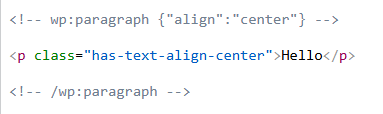
This one is almost poetic. Gutenberg — WordPress’s biggest bet of the last decade — stores blocks as HTML comments wrapped around markup, with attributes serialized as JSON inside the comment:
The structure of the page lives in comments — the part of HTML that is by definition not content. It’s a format that’s neither clean HTML nor clean structured data; it’s both at once, held together by a parser. For humans clicking in an editor, this is invisible. For a machine trying to reliably read and modify a page, it’s a fragile, WordPress-specific dialect that must round-trip perfectly or the editor breaks. AI works best with formats that are simply what they appear to be. Plain HTML is exactly what it appears to be.

The loyalist objections, taken seriously

I’ve made every one of these arguments myself, so let me answer the strongest version of each.

“My clients know how to edit WordPress.”


This is the best objection, and for years it was decisive. But be honest about what actually happens: most clients don’t edit their sites. They email their agency. In fifteen years, the number of clients who confidently used the WordPress admin beyond publishing a blog post is smaller than I’d like to admit. The dashboard — menus, widgets, theme customizer, plugin settings — intimidates them, and rightly so, because one wrong click can break a live site.


And here’s the thing: the skill clients actually have isn’t “using WordPress.” It’s describing what they want in plain language. That’s the one interface every client already knows fluently. An AI-native site meets them there.

“A well-maintained WordPress site is perfectly secure.”


True. With managed hosting, a hardened configuration, disciplined updates, minimal vetted plugins, and monitoring, WordPress is secure. But look at that sentence — it’s a list of ongoing labor and cost required to defend an architecture that is attackable by default. The maintenance retainer clients pay isn’t for improvement; it’s largely for keeping the site as safe as it was yesterday. Static output doesn’t need defending in the same way. Security you don’t have to maintain beats security you do.

“The ecosystem — 59,000 plugins — is irreplaceable.”


The ecosystem is genuinely remarkable, and for certain needs it’s still the fastest path to a solution. But audit any real site: of those 59,000 plugins, a given business site uses perhaps twenty, and half of those exist to fix WordPress itself — caching, security, SEO, image compression, database cleanup. Of the rest, most implement things — forms, sliders, tables, FAQs — that AI can now generate as bespoke code in minutes, tailored exactly, with no license fee and no third-party update risk. The ecosystem’s breadth was an answer to “no one can code everything.” That constraint is dissolving.

“WordPress is open source. You own everything.”


This matters, and I won’t wave it away. The GPL, the portability of the database, the freedom from any single vendor — these are real virtues, and any WordPress successor should be judged against them. But in practice, ask what “ownership” has meant for a site built in a commercial page builder on a proprietary hosting stack with a dozen licensed plugins. The ideal was open; the lived reality for most business sites was a web of dependencies. Meanwhile, a site delivered as clean HTML and assets is the most portable artifact on the internet. It runs anywhere, forever, with nothing to license.

“WordPress is adding AI too. Why leave?”


Because there’s a difference between a platform that uses AI and a platform designed around it. WordPress 7.0’s AI framework is real and well-engineered — but it exists to help AI operate a system built for humans: navigate the dashboard, fill the fields, manage the plugins. It makes the machinery easier to drive. The AI-native question is whether most of that machinery needs to exist at all.

And where WordPress still wins: if you run a genuine publishing operation — hundreds of authors, editorial workflows, complex content taxonomies — WordPress remains a strong choice, arguably still the best. Same for tight budgets where community support is the entire support plan. This post is about the majority case: the business and marketing sites that make up most of that 43%.

What comes next

I’m not going to pitch anything here. This post is about the shift, not a product.


But here’s what I believe the next few years look like. Websites become living artifacts rather than installations. You describe what you want — in a chat, pointing at an element on the page — and the change is generated, reviewed, and live. The site itself is clean, fast, static output: nothing to patch on the server, nothing to exploit, nothing to cache because there’s nothing slow to hide. The “management system” stops being a dashboard you learn and becomes a conversation you’re already fluent in. Design goes in one end — a Figma file, even a screenshot — and a working, responsive site comes out the other.


None of this is speculative. I’m building this way right now, for my own agency’s site first, and the experience is what convinced me to write this post. The friction I’d accepted as “just how websites work” for fifteen years turned out to be optional.


WordPress taught a generation of us — me very much included — that publishing belongs to everyone. That idea doesn’t retire. The software does.


Thank you, WordPress. Genuinely. You were the right answer to the right question for twenty years.


The question changed.

AI Tools Fail_AI Systems Win

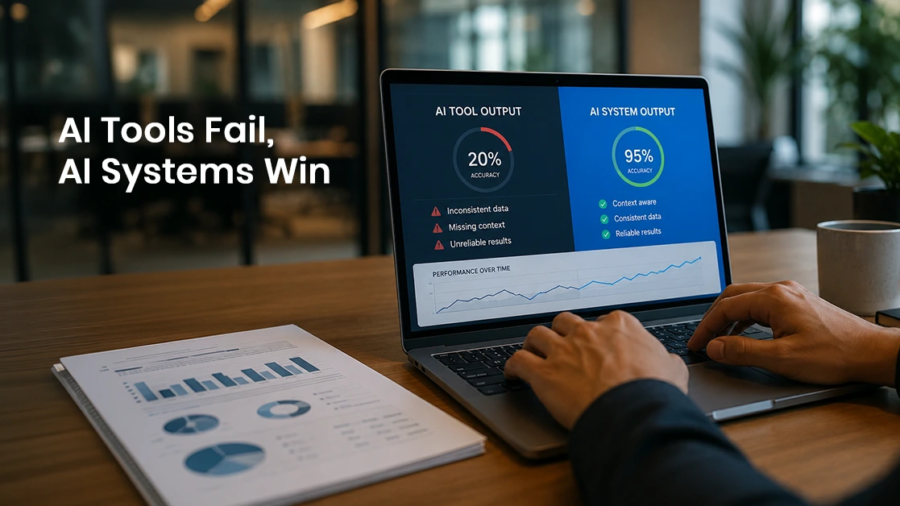
AI Tools Fail, AI Systems Win

Corporate enterprises are currently trapped in an expensive cycle of AI experimentation.
Driven by FOMO, organizations have aggressively distributed individual licenses for
standalone generative AI utilities across their departments. Yet, despite the massive
capital outlay, the promised paradigm shift in marketing velocity and performance has
failed to materialize.


The reason is fundamental: AI tools fail; AI systems win. When an enterprise treats artificial
intelligence as a collection of isolated software subscriptions, it creates an environment of operational
stagnation. True business transformation only occurs when these isolated capabilities are replaced by
integrated, custom-architected corporate marketing systems.

1. The Nervous System: Disconnect vs. Connection

The defining characteristic of an “AI Tool Island” infrastructure is a total lack of cross-platform
communication. What Claude analyzes in a market brief cannot be natively ingested by Midjourney to
inform a visual layout. Because there is no shared corporate nervous system, team members must
manually download, format, copy, and paste data across completely separate browser tabs.


An authentic AI System is unified by design. It relies on programmatic API integrations and unified data stores where every insight generated by one node automatically feeds, contextualizes, and optimizes every downstream output. The system operates as a single cohesive unit, preserving intent and operational context perfectly across copy, code, and creative assets.

2. Corporate Governance and Oversight

Distributing standalone user seats across an enterprise leaves leadership completely blind.
Organizations suffer zero visibility into exact usage mechanics, prompting a phenomenon where
enterprise tokens are burned rapidly with zero centralized intelligence derived from the expenditure.
Businesses absorb the variable overhead of AI tool consumption without building any long-term equity or retaining operational lessons.


A systemized framework changes the paradigm through centralized visibility. Every token expended and every asset engineered is comprehensively tracked. The resulting usage telemetry reveals organizational skill gaps, highlights operational workflow inefficiencies, and mathematically codifies what “good” performance actually looks like across the enterprise.

“Treating AI as a collection of software seats forces your organization into a permanent state of
operational amnesia. A marketing campaign executed in Month 12 should not look, feel, or start
from the exact same baseline as Month 1.”

3. Resolving the Knowledge-to-Cost Dilemma

Under the fragmented tool paradigm, enterprises are forced to choose between two highly flawed fiscal options: pay an exorbitant premium for top-tier enterprise multi-seat plans just to secure basic data privacy, or attempt to develop custom API software stacks from scratch, which drains internal IT resources. It is a highly punishing operational tradeoff.


An integrated, custom-engineered infrastructure completely eliminates this compromise. By deploying an API-based centralized system framework, data security is guaranteed at the pipeline level. More importantly, it shifts the financial structure from rigid, unutilized per-seat licenses to a highly optimized utility model: the organization pays exclusively for the precise processing volume consumed, and nothing more.

DIMENSIONTOOL SILOSAI SYSTEM
Disconnect Tools operate in complete isolation. No shared nervous system or data structure. Connected by design. Every internal insight continuously feeds every output.
Governance Zero centralized visibility. Tokens are burned with zero retention of core lessons. Comprehensive usage metrics unlock skill gaps and clear workflow efficiencies.
Knowledge Silos demand highly expensive enterprise plans or custom IT development. One unified platform architecture. No operational or security tradeoffs.
Cost Fixed per-seat overhead. Organizations routinely pay for 10 seats to get value from 5. Strictly API-driven. Financial outlays are tied directly to consumption.
Compounding Every creative initiative resets to zero. Month 12 performance matches Month 1. Every asset generated trains the next. The competitive moat widens daily.

4. The Compounding Advantage

The ultimate risk of relying on disjointed AI Tool Islands is the complete absence of organizational compounding. When tools are disconnected, every marketing initiative resets your progress back to zero. The software does not remember your brand voice, your historical performance metrics, or your audience preferences.


A custom-designed AI System ensures that every single campaign runs smarter than the last. Because the architecture retains context, historical performance data, and cross-functional feedback loops, the system systematically refines its own output quality over time. The performance gap between organizations running fragmented tools and those wielding an integrated enterprise system widens aggressively every single day.